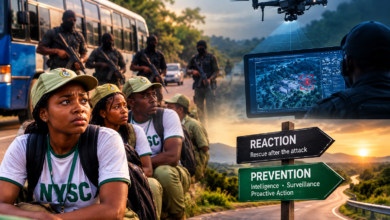
As schools reopen across the country for the 2026/2027 academic session, there is palpable fear, especially among parents, teachers and returning students themselves, that they may be taking a journey into danger instead of returning to classrooms, hostels and compounds that are safe for learning, growth and opportunity. That should not be the expectation of either the returning students, their parents or law-abiding Nigerians.
But that fear is not without justification. It was, to say the least, heightened by the recent security alert issued by the Nigeria Police Force warning of increased mobilisation of terrorist elements and possible coordinated attacks on schools, places of worship, NYSC orientation camps and other vulnerable locations. The alert further indicates that suspected terrorists and their collaborators have been conducting surveillance and reconnaissance of potential targets.
Of course, the Police have responded by announcing some measures aimed at combating the menace. Some of the measures include directing commands to intensify intelligence-led surveillance, patrols, stop-and-search operations, access control and rapid-response arrangements around vulnerable locations and tightening security at borders and major entry and exit routes. Also, the Nigeria Security and Civil Defense Corps says it has doubled its intelligence network across its commands, with a confidence-boosting claim that its intelligence-driven operations have thwarted more than 100 attempted attacks on schools.
These are welcome measures. And so is the assurance by the Federal Ministry of Education that security agencies have been alerted and that heightened vigilance is being maintained around Federal Unity Colleges. But as good and assuring as these look in themselves, the fundamental question is: How consistently are they being implemented across the country?
This is where the Safe Schools Initiative becomes critical. Established in 2014, the idea behind the initiative emerged from the painful lessons of the Chibok schoolgirls’ abduction and was intended to ensure that schools, pupils and teachers were protected from the insecurity that had increasingly invaded the education sector. Over the years, the concept has included mapping vulnerable schools, improving surveillance, facilitating rapid response and involving communities and security agencies.
Yet, more than a decade after Chibok, the country is still discussing how to make schools safe. As at the time of publication of this report, 78 children, consisting of 42 pupils and students abducted from a primary school in Mussa area on May 15, 2026, and 36 students of Government Day Secondary School, Lassa, abducted on June 29 during their NECO examinations, are still reported missing.
That is why the recent concerns expressed by the National Parent Teacher Association are particularly instructive. The association’s representative questioned whether the Safe School Initiative is actually active in schools, who is responsible for it at individual school level and where school authorities should report when they detect a threat. He called for the programme to be “dusted off and implemented properly.” These are not trivial questions, given that a national security programme is only as effective as its implementation at the point where the danger is most immediate.
It is therefore not enough for the Federal Government to announce that schools are safe. Every state government, local government, school authority and security formation should be able to demonstrate how a particular school is being protected. In other words, every vulnerable school should have a clearly identified security focal point. There should be a direct and tested communication channel between the school and the nearest security formation. School authorities should know whom to call, security agencies should know which schools are most vulnerable, and rapid-response arrangements should be tested before an emergency occurs—not improvised after terrorists have struck. This is precisely where intelligence becomes indispensable.
Security agencies must work with school authorities, parents, traditional institutions, community leaders, transport operators and residents around schools to establish a reliable early-warning system. This is the best way to forestall the reconnaissance currently being conducted around potential targets by the terrorists and their collaborators, as warned by the police. Security is a collective responsibility and that information from local communities can help security agencies detect suspicious activities early. The principle of “see something, say something” must become more than a slogan.
There is also a need to take the physical vulnerability of schools seriously. Boarding schools and schools located close to forests, highways or areas affected by banditry and terrorism deserve special attention. Where appropriate, schools, particularly in rural and remote communities, should have secure perimeters, controlled access points, adequate lighting and reliable communication systems.
Technology should also be deployed more aggressively. The proposal by the National Parent Teacher Association for technology capable of monitoring threats approaching schools deserves serious consideration. Nigeria cannot rely indefinitely on human patrols alone when technology can improve surveillance, early warning and response.
Again, the PTA’s suggestion that vulnerable pupils could instead be moved temporarily to safer schools is worth consideration. Where a school is assessed to be under an exceptional threat, government should have contingency arrangements for temporary relocation of pupils to safer schools. Closing schools indefinitely should not become the default response because it punishes children for the failures of the security system. The objective must always be to protect children and protect their right to education. This is important because prolonged disruption of schooling is most likely to expose the children to learning loss, poverty, exploitation and other social vulnerabilities. Insecurity must therefore not be allowed to become another mechanism for denying Nigerian children their future.
The present resumption should consequently be treated as an opportunity to conduct a comprehensive audit of the Safe Schools Initiative. The relevant questions to the Government should be; how many schools have been mapped for security purposes? How many have been assessed as high-risk? How many have adequate security infrastructure? How many have designated security focal persons? How quickly can security agencies respond to distress calls? And what mechanisms exist for communities to provide early warning?
There should also be regular independent assessments of the programme to ensure that all security arrangements are being executed. The recent security alert should therefore be regarded as both a warning to parents and communities, and a wake-up call to government.
In all, the protection of schools must become a permanent component of Nigeria’s national security architecture. There can be no meaningful investment in education without investment in the safety of those who receive that education. The Federal and state governments as well as security agencies must also work more closely with Parent Teacher Associations and the communities where schools are located. Fortunately, the PTA has already called for stronger collaboration and noted that parents can help sensitize children and communities on identifying and reporting suspicious activities.
Nigeria has talked about Safe Schools for more than a decade. The time has come to move decisively from Safe Schools as an initiative to Safe Schools as an enforceable national standard. As children return to school this week, therefore, they deserve more than assurances. They deserve protection. Their parents deserve confidence.
The nation owes them nothing less.