BEYOND THE PULPIT: RCCG’S HUMANITARIAN MISSION AND THE CHALLENGE TO NIGERIA’S CHURCHES

When 500 distressed Nigerians stranded in South Africa eventually board flights home, there will be more to the journey than the relief of returning to familiar soil. Behind those tickets will be an extraordinary act of private intervention in a public crisis—and a reminder of what organized faith can do when compassion is translated into action.
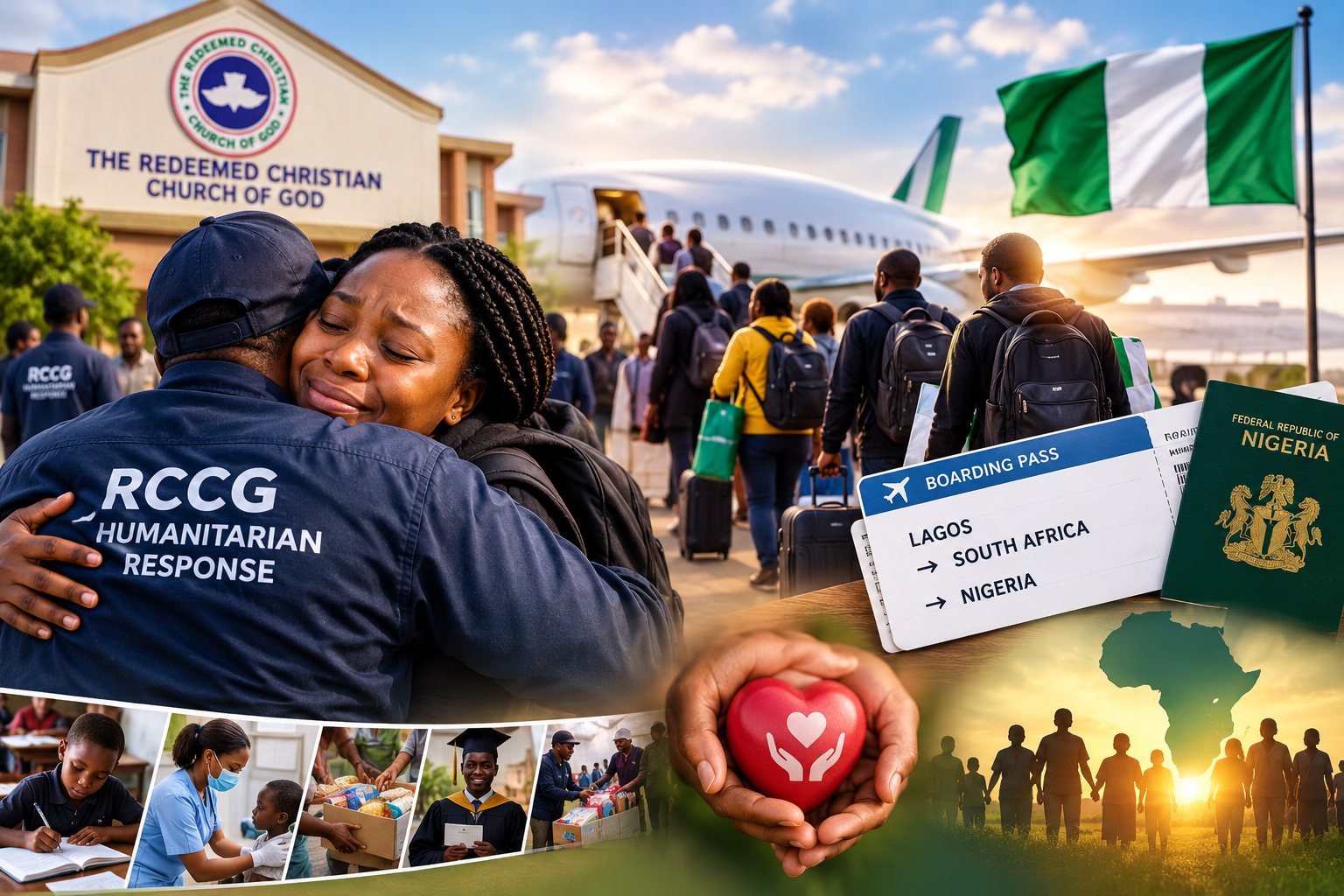
The Federal Government, last week, acknowledged the Redeemed Christian Church of God (RCCG) for donating $265,854 to finance 500 one-way tickets for Nigerians seeking to leave South Africa following a new wave of xenophobic and Afrophobic attacks. The gesture, led by the church under the leadership of Pastor Enoch Adejare Adeboye, is significant not merely because of the amount involved, but because it is a demonstration that a church can deploy its considerable institutional reach, financial resources and international network to confront a humanitarian problem beyond the walls of its sanctuaries.
Since the Federal Government began evacuating distressed Nigerians from South Africa on June 10, 2026, 1,640 Nigerians have reportedly been brought home, with government funding the return of 1,385, while philanthropic contributions have supported the evacuation of the remaining 255.
However, what makes the RCCG’s intervention more significant, especially when viewed beyond mere donation, is that apart from being a substantial share of the humanitarian burden, it points to what Nigeria’s enormous Christian community could achieve if its major churches systematically deployed a fraction of their resources and influence to humanitarian causes.
But, RCCG’s recent intervention in South Africa should not be viewed in isolation. Over the years, the church has developed a wide-ranging social intervention architecture through its various ministries, foundations, relief initiatives and humanitarian programmes. Its response to crises has included assistance to vulnerable communities, support for displaced persons, educational interventions, healthcare initiatives, food distribution and emergency relief.
The church’s international presence has also given it a distinctive capacity to respond to problems affecting Nigerians outside the country. This is perhaps one of the most important characteristics of the RCCG model.
Taken from the angle of Corporate Social Responsibility (CSR), the RCCG intervention also demonstrates that a modern church is no longer simply a congregation gathered for worship on Sundays. At its best, it can be a vast social institution with branches, personnel, volunteers, professionals, donors and networks spread across cities and countries.
With its extensive presence in Nigeria and across the world, the RCCG, is uniquely positioned to harness that network for humanitarian purposes.
The South Africa intervention demonstrates what happens when such a network is connected to a national emergency. And the distinction in the church’s intervention must not be lost to anyone. Rather than merely expressing sympathy for Nigerians facing xenophobia, the church has put money behind its solidarity.
That distinction matters, because Nigeria’s social challenges are enormous, and government alone cannot possibly address all of them. Today, millions of Nigerians struggle with poverty, displacement, unemployment, inadequate healthcare and educational disadvantage. Natural disasters, communal conflicts, insecurity and economic hardship periodically create humanitarian emergencies that overwhelm public institutions.
This is where institutions such as churches, mosques, foundations, businesses and philanthropists have an important role. Faith-based organizations are particularly significant because they possess something many government agencies struggle to maintain: deep grassroots presence and public trust.
The RCCG’s example suggests that churches can become, not merely providers of spiritual consolation, but important partners in humanitarian intervention. Indeed, the Federal Ministry of Foreign Affairs itself recognized this point when it described the church’s contribution as evidence of the impact collaboration between faith-based organizations and public institutions can have in addressing social challenges.
That partnership deserves to go further.
The South African evacuation also brings into sharper focus the continuing problem of Afrophobia and the vulnerability of Nigerians living in other African countries. The irony of this situation is that in spite of the disproportionate role Nigeria has historically played in promoting African solidarity, Nigerians living elsewhere on the continent continue to face hostility, discrimination and, in extreme cases, violence. From the liberation struggles of Southern Africa to peacekeeping operations and regional integration, successive Nigerian governments have invested enormous diplomatic, political and financial capital in Africa. Yet Nigerians continue to face rejection in these countries, this places the government in the precarious position of facing emergencies such as the South African challenges
The response cannot be left entirely to government. Churches with international footprints can play a useful complementary role by establishing welfare and emergency-response mechanisms for Nigerians in distress abroad. Such mechanisms could provide emergency accommodation, legal assistance, temporary financial support, evacuation assistance and liaison with Nigerian diplomatic missions. So, the RCCG’s intervention in South Africa could, therefore, be the beginning of a more structured partnership between Nigerian faith-based organizations and the country’s diplomatic missions.
The challenge is, however, not for every church to replicate the RCCG’s exact contribution. Rather, the challenge is to develop institutionalized humanitarian programmes that respond to clearly identified national and international needs. Imagine, for instance, what could happen if Nigeria’s largest churches jointly established a national emergency humanitarian fund. Imagine a coordinated response to displaced families in conflict-affected communities, scholarships for children who have lost parents, medical missions in underserved communities, rehabilitation programmes for victims of violence, emergency assistance for
Nigerians stranded abroad, or structured support for families facing catastrophic medical bills. The impact could be transformational. The RCCG example demonstrates, more than anything else, that Christianity is not merely about what happens inside the church. It is also about what happens to the vulnerable outside it.
There is yet a larger meaning of the RCCG gesture and it lies within the power and symbolism of bringing distressed Nigerians home. For those who have experienced xenophobic attacks, returning home is not simply a journey from one geographical location to another. It is a restoration of safety and dignity. The RCCG’s contribution therefore speaks to something deeper than airfare. It says to Nigerians in distress that they have not been forgotten. And perhaps that is the most important lesson for Nigeria’s religious institutions.