
Recently, the name and circumstances surrounding the person of Peter Obi, the Presidential Candidate of the Nigeria Democratic Congress (NDC) has dominated the nation’s media space. Top on the list has been the controversy over his stewardship as governor of Anambra State with the State Government apparently desperate to establish the falsehood in the former governor’s claim of handing over a clean bill to his successor.
Aside the controversy, which has pitted the administration of Governor Charles Soludo against the former Anambra State Governor, there have been other matters arising from individuals and groups against the same person of Peter Obi which, when taken together, seem to amount to a campaign of calumny against him.
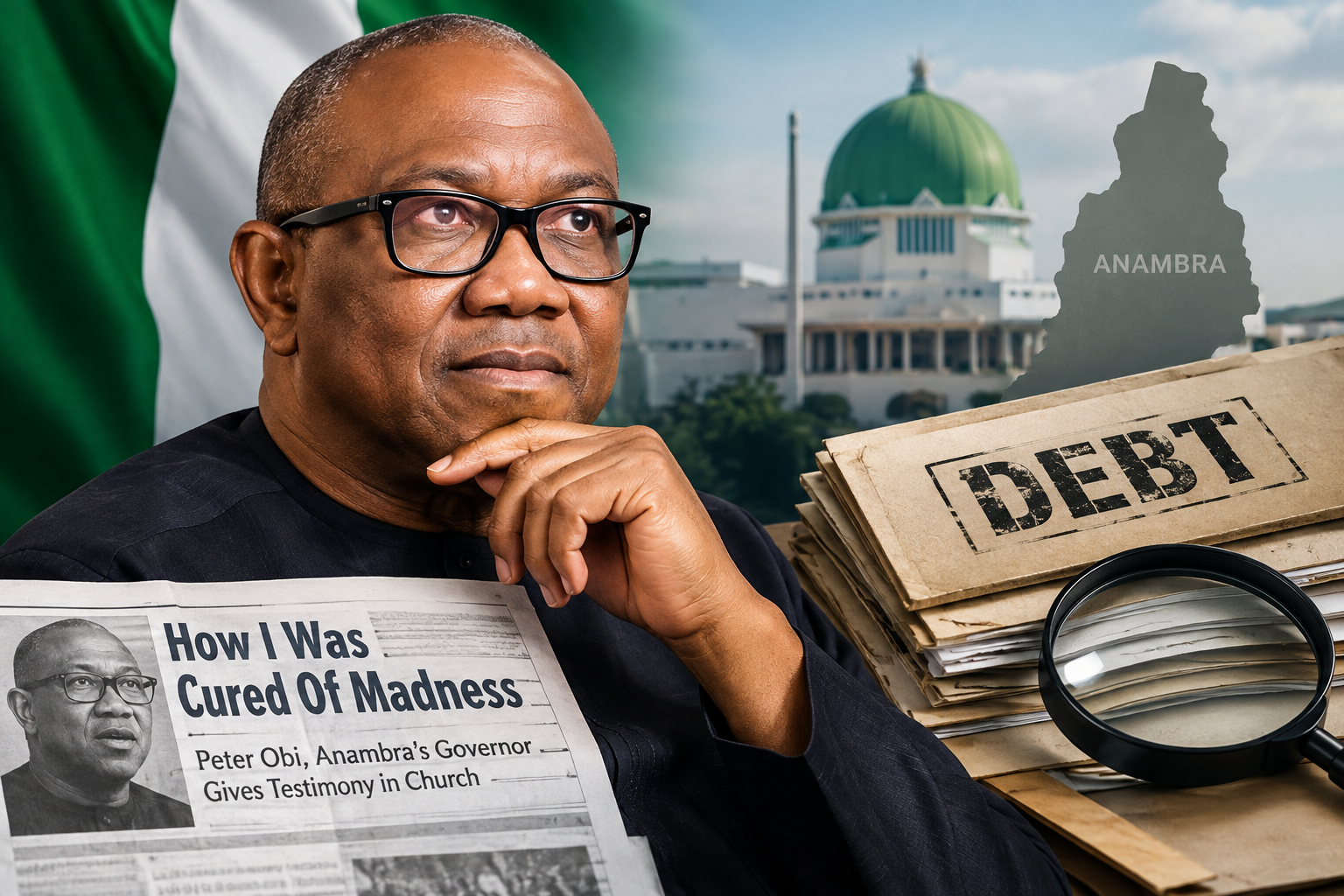
Take for example the reprint, on September 17, 2026, of a July 12, 2006 edition of PM NEWS bearing the image of a former minister with bold headline, How I Was Cured Of Madness; and substituting of the name and image of the minister with that of Peter Obi. So, instead of the former minister’s image, Peter Obi’s was printed to depict him as one who had suffered madness at one time. The rider to the caption read:
- Peter Obi, Anambra’s Governor Gives Testimony in Church.
The fraudster even left a comment wondering whether the madness was actually cured. It took the immediate intervention of the editor of the paper to correct the fake news.
Now, taking these together with the debt controversy, one is wont to ask this question that goes beyond the former governor himself: who is/are so desperate to engage in this smear campaign against Peter Obi and why? Regarding the debt controversy, for instance, why has a financial record that is more than 12 years old suddenly become such a fierce political battleground, especially as we approach the general elections?
Obi, who governed Anambra State from 2006 to 2014, says he left office without owing salaries, pensions, gratuities, contractors or suppliers whose work had been executed and certified. He has also maintained that he left substantial savings and investments for his successor. In his latest response to the controversy, he put the challenge bluntly, that if anyone could establish that he left the state in debt in the sense he described, he would abandon his 2027 presidential campaign.
But the Anambra State Government has presented a different account, quoting N127.37 billion, as of June 30, 2026, as the balance of outstanding external loan obligations connected with projects initiated during Obi’s tenure. It has also challenged his claim regarding the N2.13 billion ecological fund and disputed the assertion that his administration left more than N75 billion in savings.
The Presidency has since thrown the gauntlet to challenge Obi to quit the Presidential race. In a bold headline, after the State government made its revelation, Special Adviser to President Bola Tinubu on Information and Strategy, Bayo Onanuga, asked Obi “to honor his pledge to withdraw from the 2027 presidential race”.
Citing fresh claims by the Anambra State Government that Obi’s administration left behind unpaid loans and arrears, Onanuga declared in his X, “Peter Obi claimed he left Anambra with a clean slate of debt but the state government had since confronted him with facts and figures on Water Corporation workers, teachers, pensions and gratuities”, adding that Obi had also borrowed for “frivolous things” while in office, and asked whether the former governor would follow through on his earlier threat to withdraw from the presidential race.
Serious as this allegation is, it is equally important to establish exactly what is being called debt. A government can leave office with multilateral development loans attached to specific projects without necessarily having left behind unpaid salaries, contractors’ bills or ordinary domestic obligations.
The crucial questions, therefore, are: When were the loans contracted? By whom? For what projects? What were their repayment terms? Were they already disbursed? What portion had fallen due by March 2014 when Peter Obi left office? What was the state’s actual liability on the day Obi handed over? And, above all, what did the official handover documents say? These questions cannot be settled by political speeches.
If the Anambra Government’s N127.37 billion figure represents the present outstanding balance of development loans originally contracted during Obi’s tenure, that does not automatically mean Obi left office in March 2014 owing N127.37 billion. The amount outstanding today is not necessarily the amount outstanding when he left office. Similarly, if a loan was contracted for a multilateral development project, the relevant question is not simply whether the loan exists. It is whether it was properly contracted, whether the project was executed, whether the state received the benefit and what the repayment schedule was.
Of course, Obi’s claim that he left “no debt” should not be interpreted so broadly that it becomes immune from documentary scrutiny. If there were legally binding loan obligations inherited by the succeeding administration, those obligations should be identified transparently. This is why the argument needs an audit, not a shouting match.
But there are important pieces of historical testimony that should not be casually discarded. Ngozi Okonjo-Iweala, a former Minister of Finance and Economic Planning, now Director-General of the World Trade Organisation, publicly recalled that Peter Obi was among the very few governors who supported saving during National Economic Council discussions over Nigeria’s oil windfall. Her explanation then on the rationale for the Excess Crude Account was that Nigeria should save during periods of high oil prices so that government would have resources available when revenues declined.
The former minister’s account was that when debates over whether to save or distribute the excess revenue became contentious, Obi strongly supported the savings position. This is significant because it goes directly to the question of Obi’s philosophy on public finance. It is one thing for a politician today to describe himself as financially prudent. It is another for a former Federal Minister of Finance, who actually sat across the table from state governors during those years, to recall his position on savings.
Though that testimony does not, by itself, prove that every naira Obi claims to have saved was properly accounted for. Nor does it establish that every loan now listed by the Anambra Government was not an obligation of the state. But it does make clear that the picture of Obi as someone fundamentally hostile to fiscal discipline is inconsistent with the testimony of one of Nigeria’s most prominent fiscal managers of that period. The former Finance Minister was not the only testifier of Obi’s financial prudence.
There is also the incumbent governor of Abia State, Dr. Alex Otti, who was then the Managing Director of the then Diamond Bank (now Access Bank), one of the banks used by Anambra State at the time. Otti, while insisting that Obi left “substantial savings and investments when he finished his term in 2014”, added that the bank advised him (Obi) to invest, instead of keeping the funds in cash.
He said he helped the former governor to convert about N155 billion into dollars, which were then placed in Eurobonds and placed into tier two capital across Diamond, Fidelity and Access Banks, with maturity dates extending beyond 2014. This testimony is consistent with Obi’s claim in 2022 that he invested about $50 million each through three banks, aside leaving about N75 billion in savings.
But, perhaps the most interesting testimony of Obi’s financial prudence in this controversy came from Soludo himself. In his November 2022 response to the controversy over Obi’s investments, Soludo, while specifically acknowledging the former governor’s achievements, declared, “Peter Obi did well relatively as an APGA Governor, implementing APGA manifesto. Anambra State had the lowest unemployment rate in Nigeria at 13 percent under Peter Obi -NBS records, not Anambra State numbers, Anambra State’s poverty rate declined from 53 percent under Peter Obi to 14.78 % – as at last year- NBS not our records. Anambra State has the lowest underemployment rate at 17% under Peter Obi-NBS, not Anambra State records”.
This acknowledgement seems to defeat any argument by Soludo about the quality and value of investments Obi claimed to have made with public resources and about whether accumulating savings should be regarded as a sufficient measure of governmental performance. Soludo argued that governments exist to save lives and deliver public services, not merely to save money.
Bringing unemployment, from whatever rate, to 13 percent, reducing poverty rate from 53 percent to 14.78 percent and lowering underemployment rate to 17 percent. as recorded against the name of Peter Obi as Governor of Anambra State by the National Bureau of Statistics, is not, by any calculation or estimation, a mean achievement. In the first place, 13 percent unemployment rate means that 87 percent of employable people in the state got employment, while 83 percent of under-employed persons in the state got full employment under the administration of Governor Peter Obi.
Interestingly, in the last few days, the dispute has become much more specific, with both sides putting figures and documents into the public domain. As it stands currently, the decisive factors should be the 2014 Anambra handover financial statement, which is reportedly being currently examined; DMO records showing Anambra’s external debt on March 17, 2014, the day Obi’s tenure ended; individual World Bank/IFAD facility agreements; amounts approved, drawn and undrawn under each facility; repayment schedules and outstanding balances at handover; evidence establishing when the alleged salary/pension arrears arose; and records showing the $150 million-plus savings/investments Obi says he left behind.
These records should be placed side by side and independently reconciled. That would turn the controversy from a political shouting match into a test of public accountability. That would also establish the truth or falsehood of the claims by both sides. Until then, those who are capitalizing on the controversy to orchestrate their personal grouses against the person of Peter Obi, for any reason whatsoever, should hold their peace or look elsewhere for issues to anchor their grouses.