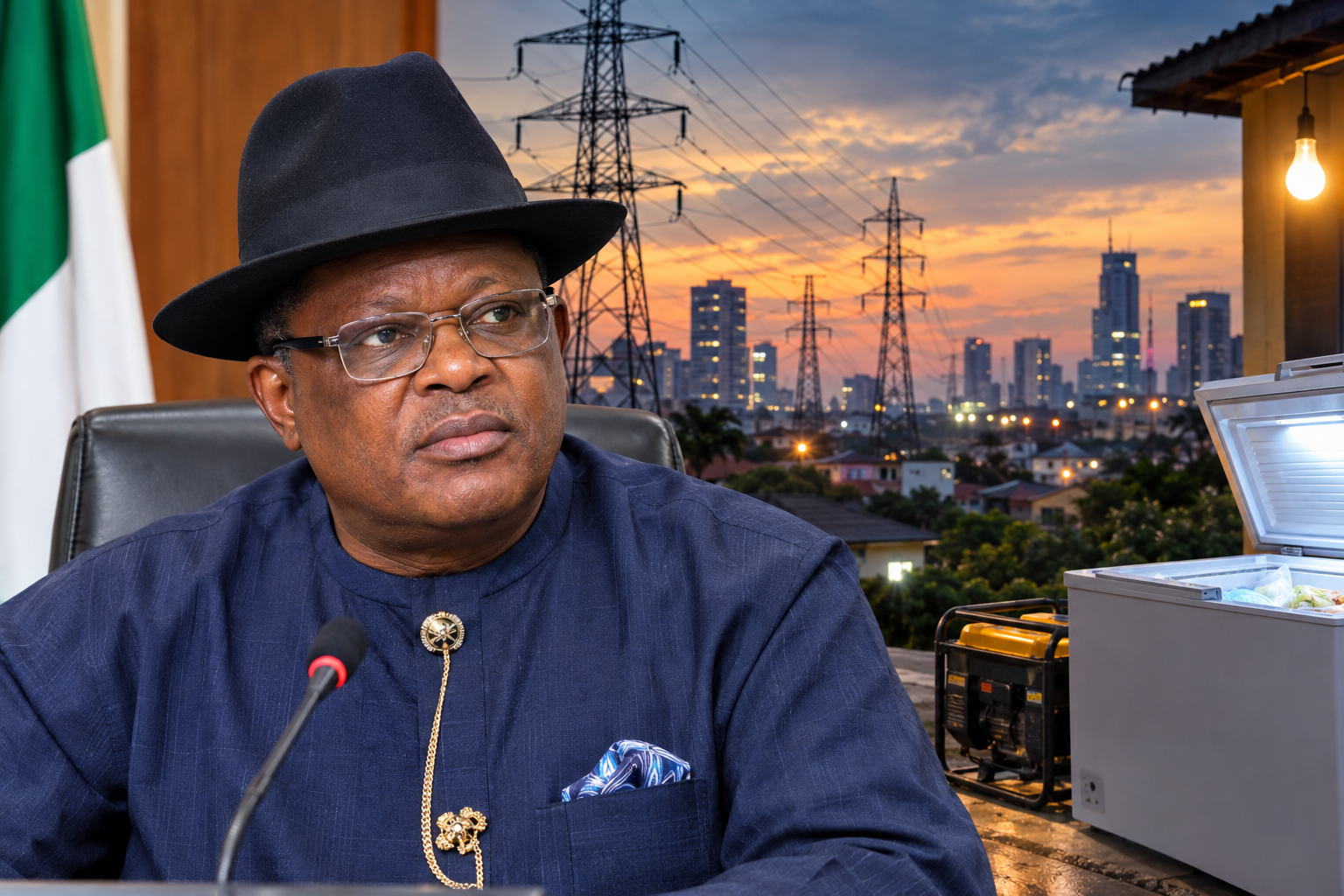

If the recent comment by the Minister of Power, Joseph Tegbe, about Nigerians asking him to “slow down” because their freezers were now working continuously, is meant as a joke, it was a most expensive one; Reasons are that, given the power situation in the country, the Minister was either trivializing a sensitive issue or playing on the intelligence of the ordinary Nigerian. Both ways, the man presented the administration he represents in very bad light.
Speaking at the commissioning of a 3MW solar hybrid power project at Yakubu Gowon University in Abuja, the minister said some areas that had gone without electricity for as long as three months were now enjoying up to 18 hours of supply. According to him, some consumers had called to say: “I should slow down, that everything in their freezer is freezing.” His response was that “that is what freezer is meant to do.”
Unfortunately, the minister, either deliberately or due to an oversight, did not give the names or locations of those “fortunate communities” where this surplus electricity that Nigerians are supposedly asking the minister to slow down. That would have added some substance to that story. But if this is really how the experience of the electricity crisis in the country is being understood at the highest level of government, then Nigerians are in deep trouble
The minister’s anecdote might have been intended as humour, or as evidence that the government’s interventions are beginning to produce results. But taken against the hard numbers of Nigeria’s power sector, it sounds less like reassurance and more like taking Nigerians for granted—or, worse, playing on their intelligence.
If he intended the remark as a humour, it was in very bad taste. If meant as evidence that the government’s interventions are beginning to produce results, the latest operational data from the Nigerian Electricity Regulatory Commission (NERC) available for April 2026 provide a sobering reality and makes the minister’s comment rather ridiculous. Nigeria had installed grid-connected generation capacity of 13,625MW, yet the average available generation was only 4,286MW—a mere 31 per cent of installed capacity.
NERC reported that the available capacity was heavily utilized, with an average load factor of 94 per cent. In other words, Nigeria is not a country awash with electricity desperately looking for consumers who will complain about their freezers becoming too cold. It is a country with a huge gap between what its power plants are theoretically capable of producing and what is actually available for dispatch. That distinction matters.
Nigeria’s installed capacity may sound impressive when expressed in thousands of megawatts. But installed capacity does not put electricity in people’s homes. What matters to households, businesses, hospitals, schools and factories is dependable electricity actually generated, transmitted and distributed to them. Indeed, the Federal Government itself has recognized the transmission bottleneck. In August, Tegbe announced a target of being able to wheel 6,000MW comfortably through the transmission system before December 2026, alongside plans to commission 20 transmission projects. If the government is still working to build the capacity to wheel 6,000MW comfortably, Nigerians may reasonably wonder why the national conversation has suddenly shifted to complaints about having too much electricity.
While it is entirely possible that some communities are experiencing substantially better supply than they did previously, improvement in selected areas should not be presented in a manner that trivializes the wider national crisis. Nigeria’s power problem is too serious for triumphalism. For decades, Nigerians have been forced to construct their own electricity systems around the failure of the national system. Generators have become household and business necessities. Petrol and diesel have become alternative electricity fuels. Companies have factored self-generation into their operating costs. Small businesses have watched scarce profits disappear into energy expenses. For such Nigerians, the freezer is not the symbol of an electricity problem. The freezer is one of the victims of the electricity problem.
When power is available only intermittently, a freezer cannot perform its basic function efficiently. Food is lost. Medicines requiring refrigeration are placed at risk. Businesses that depend on cold storage suffer. Household expenditure rises because generators have to be deployed whenever the grid disappears. Therefore, the real achievement should not be that a freezer is freezing continuously for a few days or weeks. The achievement would be for Nigerians to know, with reasonable certainty, that electricity will be available tomorrow, next week and next month. That is the standard by which the power sector should be judged.
The minister himself acknowledged the scale of the problem when he noted that some of the country’s electricity infrastructure is more than 40 years old and needs systematic replacement. He also disclosed that three transmission towers in Birnin Kebbi had recently been brought down by vandals. These are the realities that deserve the minister’s attention and not an isolated case of improvement in power supply
Nigeria needs more generation. It needs stronger transmission. It needs better distribution networks. It needs modern transformers, substations and metering. It needs protection against vandalism. It needs investment in renewable energy and storage. And, critically, it needs a power market capable of attracting the investment required to make electricity supply commercially and technically sustainable.
There is another important point. The Federal Government’s own target of wheeling 6,000MW before December is an implicit acknowledgement that Nigeria still has a long way to go. Six thousand megawatts should not be an extraordinary national ambition for a country of Nigeria’s population and economic aspirations. It should be a stage in a much larger journey toward an electricity system capable of powering industrialization.
Nigerians do not want electricity merely long enough to freeze their food. They want electricity to power factories, preserve jobs, operate hospitals, illuminate schools, run businesses, support digital enterprises and drive economic growth. They want to stop buying generators, stop buying petrol and diesel to generate electricity, stop calculating whether the next power outage will destroy their appliances. And they want an electricity system that works without requiring them to telephone the Minister of Power to complain that their freezers are freezing.
The minister may have intended his comment as a light-hearted illustration of progress. But in a country where the latest available NERC figures show that only 4,286MW out of 13,625MW of installed grid-connected capacity was available on average for dispatch, thejoke risks obscuring the much bigger story. Nigeria does not have the luxury of treating electricity as a problem because a few consumers allegedly have too much of it. The real paradox is that in Africa’s most populous country, reliable light remains remarkable enough to make headlines.
The objective should therefore be neither to slow down nor to celebrate prematurely. The objective should be to keep going—until reliable electricity is no longer a novelty, until freezers can freeze without becoming a national joke, and until Nigerians can finally regard electricity as basic infrastructure rather than a favour from government.
By MAC DURUGBO