


The latest abduction of prospective members of the National Youth Service Corps (NYSC) along the Owerri-Onitsha Road in Imo State is yet another disturbing episode in Nigeria’s seemingly endless catalogue of kidnapping incidents. It brings to the fore the fact that there is something fundamentally wrong with a national security system that can locate kidnappers only after they have abducted its citizens.
It is a painful reminder that, instead of being largely reactive, Nigeria’s security architecture desperately needs a system that anticipates, prevents and disrupts attacks before innocent citizens become victims. The prospective Corps are young Nigerians traveling to orientation camps to perform a national obligation. They were not soldiers entering a battlefield. They were graduates answering a call to national service. Yet armed men reportedly stopped their buses, marched them, along with other passengers into the bush, thereby turning a federal highway into a theatre of criminal enterprise.
The most disturbing part is that the security agencies on the rescue operation reportedly deployed drones and succeeded in locating the abductors’ hideout, but could not proceed because, according to them, intelligence indicated that the camp may have been planted with improvised explosive devices. In other words, the security agencies apparently found the kidnappers but only after they had secured their victims.
Much as the Federal Government deserves credit whenever its security agencies successfully rescue abducted Nigerians, and the troops and police officers, who risk their lives confronting terrorists and kidnappers, deserve commendation, better equipment and improved welfare, rescue cannot become the principal measure of security success. It is not enough for either the government or its security agencies to continue to congratulate themselves for rescuing citizens or treat every successful rescue as the end of a security operation. Instead, such successes should trigger an examination of how the attack occurred, why intelligence did not prevent it and what structural failures allowed the criminals to operate. Otherwise, the country merely celebrates its ability to manage the consequences of insecurity while leaving the causes intact. This is precisely why Nigeria’s counter-terrorism strategy must change.
The NYSC incident provides a particularly disturbing example. The victims were traveling along a major highway. Their movement was not clandestine. They were part of a national programme administered by the Federal Government. Their destinations were known and their journeys were predictable. Yet criminals were apparently able to exploit this predictability. This, and the fact that the criminals are consistently turning the nation’s highways into a battlefield, should be unacceptable
The Nigerian security policy has, for too long, been dominated by the language of response. The routine has always been, troops have been deployed, suspects arrested, hostages rescued, weapons recovered and terrorists neutralized, end of story until another incident. But the real test of a modern security system is whether it can identify danger before it materializes. Nigeria’s highways, particularly those passing through forests and poorly secured stretches of territory, have become increasingly attractive to kidnappers because criminals know that they can ambush travelers, disappear into difficult terrain and negotiate ransom from positions of relative safety.
That, in itself, is a failure of territorial control. A sovereign state should know the dangerous corridors within its territory. It should know where criminal camps are located, the routes criminals use to move men, weapons and victims, the communities and networks that facilitate their operations, and most importantly, the capability to disrupt those operations before criminals reach the highway.
Unfortunately, the cycle has often been to wait for the attack, then hold emergency meeting after which troops are deployed, followed by the search. Then the negotiations, after which victims are “rescued”. The press statement is then issued, followed finally by the familiar assurances that such incidents will not happen again. Until the next one. To end this vicious cycle, the Federal Government must now move decisively from a predominantly manpower-based security strategy to an intelligence-led architecture. Nigeria needs a national security system capable of seeing threats before they become attacks.
Surprisingly, the security agencies on the trail of the kidnappers said they deployed drones to locate the precise place the kidnappers held their victims. It then raises the question; If those drones could locate the camp of the criminals after the abduction of the victims, why couldn’t they be deployed to monitor that forest and other known criminal corridors in the state. That is why drones, satellite imagery, electronic surveillance, intelligence databases, night-vision equipment, aerial reconnaissance and secure communications should be integral to the nation’s conventional security instead of being treated as sophisticated additions to the system.
There is another dimension that cannot be ignored. The call for prevention must not become an excuse to understate the importance of combat readiness and the welfare of the nation’s security personnel. This is because prevention requires a security force with superior intelligence, mobility, firepower and technology. The Nigerian Army, police and other security agencies cannot be expected to confront heavily armed criminals hiding in forests with inadequate intelligence, obsolete equipment or insufficient logistical support.
Nor should the welfare of personnel be treated as an afterthought. A soldier operating for days in hostile terrain needs proper accommodation, feeding, medical care, communications, protective equipment and reliable transportation. A policeman deployed to a dangerous highway needs appropriate weapons, vehicles, communication systems and intelligence support. And when personnel are killed or injured in the line of duty, their families must not be left to navigate bureaucratic obstacles before receiving the benefits due to them. A country cannot demand extraordinary sacrifices from its security forces while providing ordinary support. Troops’ welfare is therefore not charity. It is part of national security.
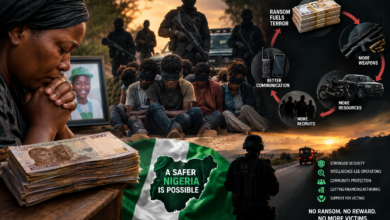
There is also a financial dimension to the problem. Kidnapping has survived because it has become profitable. Criminals abduct Nigerians because ransom payments provide an economic incentive. Every successful operation provides money to buy weapons, recruit fighters, maintain camps and finance subsequent attacks. The government must therefore attack the economics of kidnapping with the same determination with which it attacks the kidnappers themselves. Financial intelligence must be strengthened. Ransom networks must be traced.
Financiers, informants and facilitators must be identified and prosecuted. Those providing weapons, vehicles, communications equipment and safe houses to criminal gangs must face the full force of the law. The forests must no longer be treated as ungoverned spaces where criminals can establish camps with impunity. Clearing an area once is not enough. Security presence must be sustained afterwards. Otherwise, the criminals will simply return.
Protecting NYSC members must become a priority. The NYSC case also demands a rethink of how prospective corps members travel to orientation camps. The Federal Government requires young Nigerians to travel across state boundaries in fulfilment of a compulsory national programme. It therefore has a moral and constitutional responsibility to provide a security framework commensurate with that obligation. That should include provision of transport facilities and a coordinated system for monitoring members’ movements along identified high-risk routes.
There should be accurate manifests. There should be emergency communication channels. There should be intelligence-based travel advisories. And where intelligence indicates serious threats along particular corridors, appropriate security arrangements should be made before buses carrying prospective corps members are allowed to pass through them. The state cannot compel young Nigerians to travel for national service and then leave them to negotiate the dangers of Nigeria’s insecure highways on their own.
The most dangerous feature of Nigeria’s security crisis is perhaps the persistence of a system that allows them to operate long enough to become strong. Criminal gangs require territory, weapons, money, informants, logistics and communication. They require access to victims, safe routes and safe havens. Every one of these requirements represents an opportunity for the state to intervene. The failure is that too many interventions occur only after blood has been spilled. So, measuring security by the number of criminals killed after attacks must now give way to measuring it by the number of attacks prevented. That is the standard that matters.
For now, the immediate priority must remain the safe recovery of every prospective corps member still in captivity. But when the immediate crisis is over, there must be an honest investigation into how the kidnappers obtain intelligence about the travelers, whether there were warnings about the route, whether there were security gaps, available intelligence that was not acted upon and whether or not the victims were properly monitored. Also, investigation should establish how the criminals were able to operate a camp close enough to a major highway to carry out such an audacious operation and who will be held accountable if institutional failures are established. These details matter in order to secure the highways and prevent future occurrence.
The NYSC abduction should be a wake-up call for action. For every Nigerian taken hostage, there are families plunged into fear, businesses disrupted and confidence in the state diminished. The ultimate responsibility of government is to build a country in which citizens can travel, work, study and serve their nation without living in fear of being abducted.
Nigeria needs a security system that prevents the attack. That is the difference between merely fighting terrorism and defeating it.




This is so true. May God deliver Nigeria ❤