Terrorism and kidnapping for ransom, seems to have gained a foothold in Nigeria today. From current reports hundreds of citizens are being held in captivity by terror gangs across the country. When considered against the backdrop of its social consequences, the situation is, indeed, frightening. Aside creating fear, the terror and kidnap gangs seize innocent people, threaten their lives, and then force the government, families and society to pay for their freedom. That is fast becoming the norm in Nigeria today. And because of the seeming uncoordinated efforts in the nation’s antiterrorism strategy, the malaise is becoming a business model.
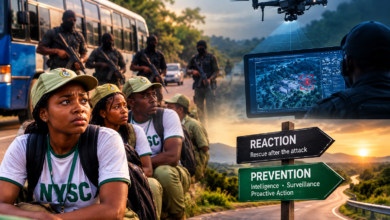
Recall, for example, the kidnapping of twenty prospective National Youths Service Corps (NYSC) members on their way to Imo State on October 1, and the haggling between the kidnappers and parents of the Corps members over their ransom price; as if they were common commodities in the market. These are children of families who invested so much in their education and are obviously looking forward to reaping the fruit of their labour. Instead, they were forced to cough out millions of Naira to save their lives. Though they have regained their freedom after what police described as coordinated action by security forces, it was, reportedly, not without some ransom.
This is why Nigeria must make a fundamental choice in its current war against terrorism and kidnapping. While lives of hostages must be protected and every legitimate effort made to rescue them, terrorists and kidnappers must never be allowed to profit from the taking of human beings. As difficult as this balance could be to achieve, it happens to be the only policy that will ensure enduring success in the current counter-terrorism battle in the country.
A no-concession policy, of course, should not be a policy of indifference. The concerns and anxieties of parents and relations of kidnapped victims must be factored into the policy to create a synergy that will continually assure all concerned that efforts are alive to achieve both the safety and rescue of the hostages. The government must be prepared to communicate, gather intelligence, establish channels of contact where necessary and explore every lawful avenue capable of securing the safe release of victims.
But neither should the anxiety and emotions of the victims’ relations become an excuse for financing the criminals who took them, nor should communication with the kidnappers result in capitulation. Negotiation, where unavoidable for intelligence or humanitarian purposes, should not mean paying ransom, releasing terrorists, surrendering territory or accepting conditions that strengthen the perpetrators.
The greatest danger of ransom is not simply the money that changes hands. It is what that money makes possible afterwards. Every successful ransom payment can provide criminals with the resources to acquire weapons, motorcycles, vehicles, communication equipment, food, intelligence and recruits. More importantly, it sends a message to the criminal network that kidnapping works, and that abducting a Nigerian has a reasonable prospect of financial reward. The next victim is therefore not simply an unfortunate individual but another potential source of income. This is a vicious cycle, which all concerned, but especially relations of victims, must be made to understand.
Kidnappers’ greatest weapon is fear. And that is why they exhibit such cruelty whenever and wherever they strike. Fear then creates pressure and pressure produces ransom on which the criminals depend to finances their nefarious acts. It is, therefore, clear that if this vicious cycle is allowed to continue unbroken, Nigeria will inadvertently be sustaining the economics of terrorism, and, so, cannot defeat terrorism. This is why the policy of refusing ransom should be understood by all not merely as a moral position but as a national security strategy.
It must be understood by all concerned that Nigeria is not alone in the dilemma of confronting the agonizing question of what governments should do when innocent citizens are held hostage. The world has wrestled with the same dilemma. The United States, for example, has maintained a longstanding policy that its government will not make concessions to terrorists holding American hostages. Their stated reasoning is particularly relevant to Nigeria because concessions can only increase the danger that more people will be taken hostage.
The distinction, perhaps, is that the American policy has explicitly provided for the use of every appropriate resource to secure the safe return of hostages while denying hostage-takers the benefits of ransom, prisoner releases or other concessions. The country has also made it clear that a no-concessions policy does not necessarily prevent communication with hostage-takers. In other words, there is a difference between talking to terrorists and surrendering to them.
That distinction deserves serious attention in Nigeria. It makes the difference between gathering intelligence and giving criminals what they demand. It says that while it is legit to open a channel of communication in order to save lives, it should not lead to an arrangement that strengthens the kidnappers. The objective must always be the safe recovery of the hostage without increasing the capacity of the hostage-taker to repeat the crime.
However, in adopting this policy, there is need to make it credible. Fortunately, the present administration has consistently stated that it will not pay ransom or negotiate with criminals. In July 2026, President Bola Tinubu said the government had refused ransom and prisoner-release demands in connection with the abduction of 44 pupils and teachers in Oriire, Oyo State, while stressing that the government was strengthening its security architecture to defeat terrorism and banditry. This position, if sustained, is important and a positive step in the ongoing counter-terrorism,
The policy is, however, only as credible as the capacity behind it. If government says it will not pay ransom, Nigerians must see an alternative rescue architecture capable of producing results. There have already been instances that demonstrate that such an approach is possible. In June, the Borno State Government said 360 abductees rescued from a terrorist enclave in the Mandara Mountains were recovered through an intelligence-driven military operation and denied that ransom was paid. Such operations should become the model, not the exception. It gives the clear and unmistakable message to kidnappers, that taking hostages would never guarantee them money.
That is where the families and relations of the kidnap victims come in, and this is where the Nigerian government faces perhaps its most difficult responsibility. While it could be easy for an official sitting in Abuja to announce that government would not pay ransom, the reality is that it would be considerably harder for the father whose daughter has been taken, the mother whose son has disappeared, or the wife whose husband has been abducted to accept that principle while knowing that a loved one may be somewhere in a forest or terrorist camp. While the issue could be a matter of government policy, for such families it is personal. The emotional trauma could be quite devastating.
That is why government must handle the issue very carefully with the understanding that a no-ransom policy requires a corresponding policy of reassurance, communication and support for victims’ families. Families must never be left to depend on rumours, social media posts, anonymous telephone calls or information from the kidnappers themselves. They need a designated government contact, regular briefings with assurance that their case remains active. They need to know what security agencies are doing, even when operational secrecy prevents disclosure of specific details. And, above all, they need to believe that their loved ones have not been forgotten.
All these needs are meant to keep the confidence of the families alive while negotiations are going on and security decisions are being taken. This is because confidence is part of the rescue operation and national security. The truth is that without confidence in the government, families could compromise intelligence operations and expose other victims to greater danger. There is, therefore, need for the government to build a system in which families understand the policy and trust the process. In other words, the message “no ransom” must be followed with an assurance that the victims will not be abandoned. That distinction could become the foundation of a credible national hostage-recovery policy.
Nigeria needs a clearly articulated national hostage-response framework, which should establish, among others, who takes command when mass abductions occur; who communicates with families; how intelligence is coordinated; how ransom demands are handled; how victims are medically and psychologically supported after rescue; and how information is communicated without compromising military operations. Most importantly, government should establish a culture of persistent pursuit. A hostage must not become yesterday’s news simply because the media cycle has moved on.
But above all, the best hostage-rescue operation is the one that never becomes necessary. Nigeria has spent too much time reacting to kidnappings after they occur. The country needs to move aggressively towards prevention. That means intelligence-led policing; effective surveillance of forests and criminal corridors; control of ungoverned spaces; protection of vulnerable communities; rapid-response capabilities; stronger border security; better inter-agency intelligence sharing; protection of schools and highways; and a serious campaign against the financing networks that sustain kidnapping.
Again, the Tinubu administration has recognized the need for a broader counter-terrorism architecture. In his 2026 budget speech, the President described a new national counter-terrorism doctrine built around unified command, intelligence gathering, community stability and counter-insurgency, while declaring that armed groups operating outside state authority would be treated as terrorists.
That architecture must now move from policy language to measurable results. This is because terrorists do not operate only through guns. They also operate through economics. They need money; they need informants, safe houses, food and logistics, communication and weapons. They need networks without which it will be impossible for them to operate. Cutting those networks is as important as chasing the gunmen.
So, while the security agencies must be commended for their rescue strategy by which the Corps members regained their freedom, it must be said that the most effective counter-terrorist strategy is to cut their sources of financing. Nigeria must therefore treat ransom as part of the wider terrorism-financing problem, because the ransom paid for one hostage may help create the conditions for the abduction of another A criminal organisation that kidnaps ten people and collects millions of naira has potentially generated capital for its next operation. This is why the price of appeasement is ultimately paid not only by the family that loses money but by the entire country.