Nigeria @ 66: Tinubu’s Independence Anniversary Speech vs The Trauma of Broken Promises

By Mac Durugbo
While addressing the nation on Nigeria’s 66th Independence anniversary, President Bola Tinubu declared, among others, that the country had “corrected its course”, that the difficult phase of economic reform was over and that “the age of prosperity” had begun. Envisioning a nation where prosperity would be broadly shared, with every child dreaming beyond the circumstances of birth, and Nigeria’s enormous potential finally being reflected in the lives of its people, the President declared, “The Promised Land before us is a Nigeria of abundance and opportunity”.
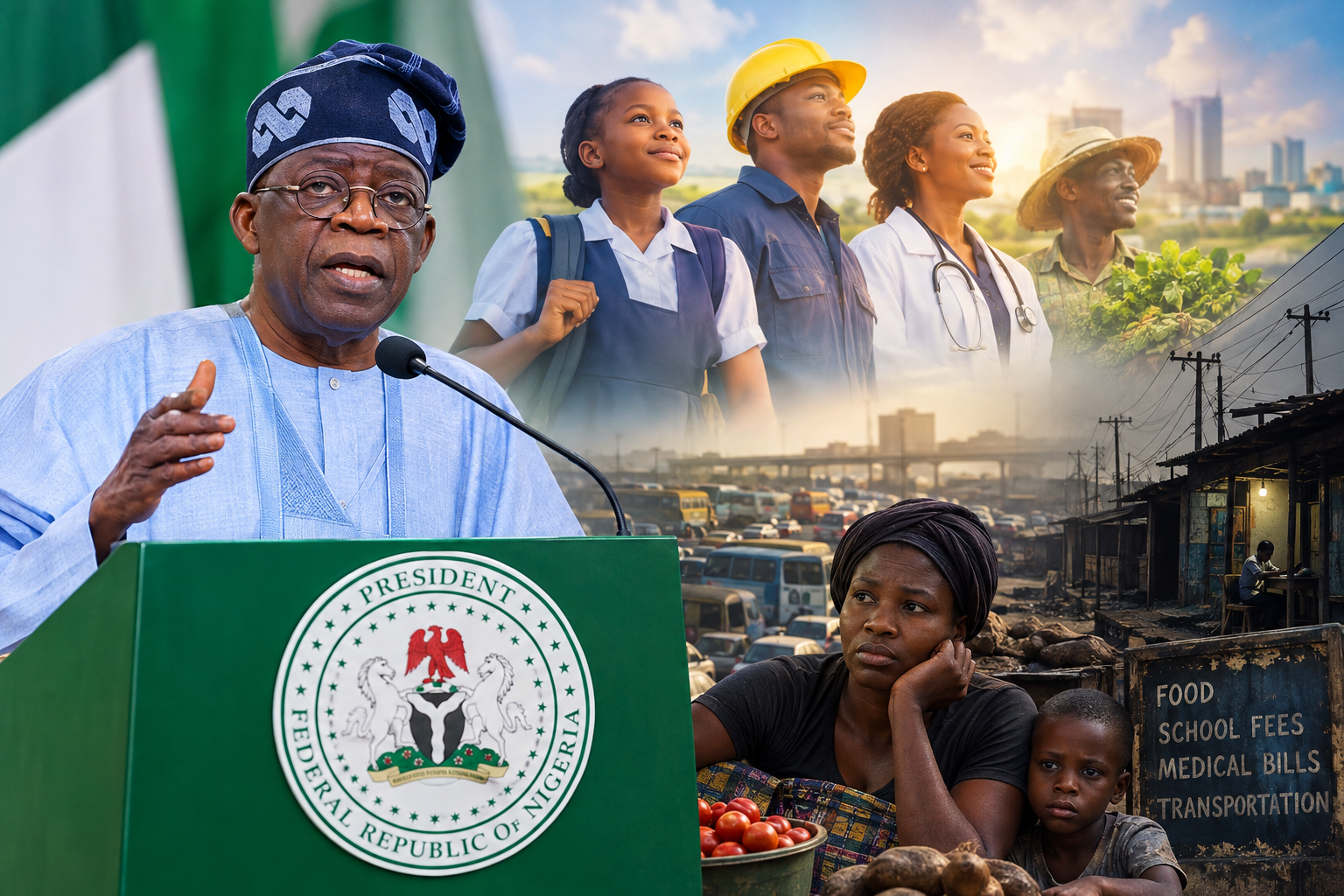
It was, indeed, an inspiring vision, with a familiar ring. There was, for example, the language of hope, sacrifice, a difficult journey finally approaching its destination, and, of course, the promise of a better tomorrow. But by far, one of the strongest parts of his address was his acknowledgement that millions of Nigerians are still struggling with food, school fees, medical bills and transportation, difficulties which he attributed to accumulated consequences of decades of low productivity, inadequate infrastructure, insufficient opportunities and failed institutions. He argued that his administration chose to confront rather than postpone these economic distortions.
The President maintained that his economic reforms have produced significant improvements: economic growth of more than four per cent, lower inflation from its peak, stronger foreign reserves, greater stability in the foreign-exchange market and record non-oil export revenue exceeding $6 billion in 2025. These are claims that can—and should—be subjected to independent economic scrutiny.
His most profound assurances that “The emergency treatment is over, the foundation has been repaired and our nation’s course has been corrected”, if taken literally, mean that the economic hardship Nigerians have borne in the last three and a half years are now over. Prosperity must now translate to a farmer being able to cultivate safely and earn a decent income; factories having reliable electricity; young people finding productive employment; food and transportation becoming affordable; education becoming accessible and families being able to look to the future with confidence. Indeed, this is a big promise which could be described as most inspiring.
There is, however, something that no presidential speech can easily erase, and that is the memory of promises which Nigerians have heard for decades without seeing them fully translated into the realities of their daily lives. For a Nigerian population that has listened to successive governments make remarkably similar promises since independence, inspiration is no longer enough.
The people want manifestationofthe promise in the price of food, feel it in their pockets, see it when they switch on the light, experience it on the roads, encounter it in hospitals, schools, farms, factories and workplaces. Above all, they want government promises to transcend Independence Day speeches and become measurable improvements in their quality of life. That is the burden President Tinubu now carries.
The Nigerian tragedy is that since Independence, the promises have rarely changed – food security, affordable housing, good roads, reliable electricity, quality education, accessible healthcare, employment, security and economic prosperity. The language may have changed over time as political parties changed, as military governments held sway, and as democratic administrations succeeded one another. But the basic national expectations have remained remarkably constant.
Electricity provides the clearest illustration of this recurring cycle. Successive administrations have announced ambitious megawatt targets. President Olusegun Obasanjo pledged 10,000MW in 2003. President Muhammadu Buhari later campaigned on expanding generation and distribution towards 40,000MW within four to eight years. Yet an Africa Check review found that none of the major electricity projections it examined had been achieved, with Nigeria’s then-record transmission peak standing at 5,222.3MW in December 2017.
It is significant, at this juncture, to note that the only time the nation made significant progress, especially in transmission, was under Babatunde Fashola SAN as Minister of Power, Works and Housing. Transmission increased, for the first time, from a little above 5,000 megawatts to 7,124 MW between 2015 and 2018. This is significant because after him, reliable power seems to have relapsed again to a national economic constraint.
It is, therefore, not by choice that Nigerians believe every government is deliberately lying. Too many promises have become detached from outcomes. So, the average Nigerian citizen has become a sceptic. As a result, when a government announces a new road, citizens ask when it will actually be completed. When a government promises electricity, they ask whether the transformer will work. When government announces agricultural programmes, farmers ask whether fertilizer, irrigation, storage and markets will actually reach them. When politicians promise jobs, young Nigerians ask where the jobs are. When government announces measures to reduce the cost of living, households ask whether the price of rice, bread, transport, rent and electricity will actually fall.
That is a result of accumulated experience and it presents the Tinubu administration with a challenge that goes beyond defending its economic reforms. That challenge is lack of trust. The government must rebuild trust. In his Independence Day address, the President again defended his position that the removal of the petrol subsidy and the reform of the foreign-exchange system were necessary to rescue the economy from deeper structural problems, comparing Nigeria’s inherited economic problems to cancer requiring painful treatment rather than temporary pain relief.
But while it may be argued that social consequences of economic reforms are painful, the question for citizens is: What have Nigerians received in return for the sacrifice? That question cannot be answered indefinitely with another promise that the benefits are coming because reform cannot remain an article of faith. It must translate to better life for the Nigerian people.
Given the International Monetary Fund acknowledgment in June 2026 that in spite of improved macroeconomic outcomes and resilience, the conditions for many Nigerians remained difficult and the World Bank similarly report that poverty remained widespread, despite improvements in macroeconomic stability, the paradox confronting the Tinubu administration is that when, for too long, the economy improves only on paper while the citizen remains poor in practice, that economic reform becomes vulnerable to public rejection.
The President, however, appears to understand this and has therefore moved the goalposts from reform to prosperity. His message, taken holistically, is: “the emergency treatment is over. The foundation has been repaired, and the central economic task has now changed from correcting the nation’s course to delivering shared and widespread prosperity.” In other words, Nigerians should assume that government has diagnosed the problem and are now ready to deliver the cure.
Fortunately, the President has supplied his own measuring instruments. By promising cheaper food through greater agricultural productivity, irrigation, mechanization, storage and transportation; more productive employment; industrial growth; reliable power for factories; digital connectivity; stronger social protection; better primary healthcare and basic education; support for businesses and young entrepreneurs; and above all, that Nigeria’s enormous natural and human resources would finally be converted into opportunities for its citizens, he has now provided benchmarks against which the administration’s performance can be measured.
Moreover, his own definition of prosperity as lived experience rather than abstract statistics seems to tally with the reality that Nigerians are now eager to begin to live the promises, and not listen to them. Cost of living is the immediate challenge of the administration. Recent increases in petrol prices have demonstrated how vulnerable Nigerian households remain to energy costs and international oil-market movements.
Reuters reported in September that petrol prices had risen to around ₦1,400 per litre in Lagos and Abuja, with some northern locations reaching about ₦1,500, while diesel prices exceeded ₦2,000 per litre. It also reported renewed pressure on households despite easing inflation. For the trader, the farmer, the transporter and the ordinary wage earner, the price of petrol determines the cost of transportation, affects the cost of moving food, influences the price of manufactured goods, affects the cost of running generators, and eventually appears in the price paid by consumers.
Consequently, the ultimate test of the reform is how soon Nigerians will begin to experience a sustained reduction in the cost of living. The sooner this is done, the sooner trust will be rebuilt. The President has asked Nigerians to “keep faith with Nigeria”. But faith, in public administration, must eventually be reinforced by evidence.
A citizen who has spent years listening to promises about electricity cannot be expected to celebrate another electricity promise simply because it is eloquently delivered. A young graduate who cannot find work will not be comforted indefinitely by statistics about GDP growth. A mother struggling to feed her children cannot pay her food bill with foreign reserves. A farmer cannot take macroeconomic stability to the market. In other words, the citizen needs results.
That is why the President’s declaration that “our destination is in sight” carries an obligation. The closer the destination is said to be, the less acceptable it becomes for Nigerians to remain stranded along the road. The clock has already started ticking
But there is another reason why this Independence Day speech deserves particular scrutiny. The address, which is his fourth, comes as Nigeria moves towards the 2027 general election. His administration has therefore entered the phase in which promises will increasingly be measured against an established record rather than intentions.
As much as the President’s assertion that Nigeria cannot erase in four years what accumulated over generations, is correct, it is equally correct that if some problems require generations to solve, the government must demonstrate that it could solve them irreversibly. Nigerians need to know that the country is genuinely moving in a direction from which future governments cannot easily reverse. That means functioning infrastructure, reliable electricity, productive agriculture, affordable transportation, competitive industries, jobs, effective schools, accessible healthcare, greater security, and, above all, an economy in which working harder actually produces a better life.
Finally, the title of this piece, “The trauma of broken promises”, which is borrowed from a story of same title, depicts a situation where the people had been so traumatized by failed promises that they chose not to believe their leaders. It was a defence mechanism rather than deliberate act. This is, perhaps the greatest danger confronting Nigeria at 66; the fact that Nigerians have learned to hope cautiously. It is a national tragedy, in that no country can build a prosperous future when its citizens no longer believe official assurances.
This is deeper than any individual failed project, because it corrodes the relationship between citizen and state, teaches young people to expect less from government., encourages talented Nigerians to look abroad for opportunity, weakens public confidence in institutions, creates fertile ground for populism, anger and political distrust, and makes even credible promises sound like familiar political slogan.
The Tinubu administration must, therefore, understand that its most important task in the remaining period is to deliver its promises differently. That is why the “Promised Land” must become visible and his powerful appeal of “No looking back” must also mean “No postponing”. If the reforms have truly laid the foundation for prosperity, then the prosperity must begin to manifest in the lives of Nigerians.
Let the farmer see it in his income, the worker in his purchasing power and the entrepreneur in access to credit and reliable electricity. Let the student see it in the quality of education, the patient in the hospital, the commuter in transportation costs, the family in the price of food and the young graduate in the availability of productive work. Let every Nigerian see it in greater security and dignity. That is how the trauma of broken promises can begin to heal. After six and a half decades, what Nigeria desperately needs is delivery.
With the President’s declaration that Nigeria has passed her “Red Sea” and that the “Promised Land” is in sight, the responsibility now is to ensure that Nigerians do not have to wait another generation to discover whether the promise was real. At 66, the time has come for the people to see, feel and experience the prosperity they have been promised for generations.