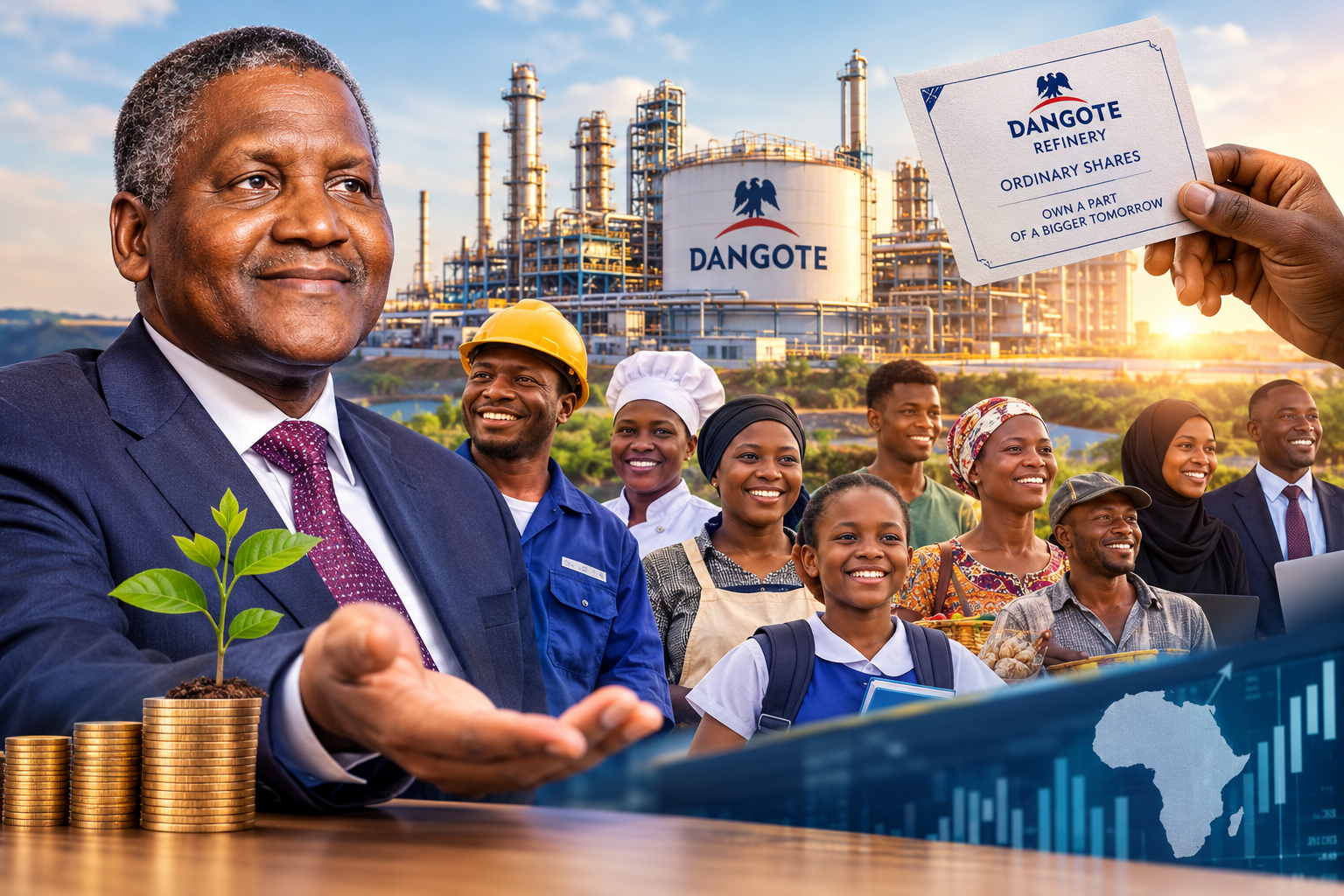
WHEN THE POOR BECOME STAKEHOLDERS: THE HUMANITARIAN INVESTOR IN ALIKO DANGOTE

The most familiar way of telling the story of Aliko Dangote, perhaps, is that he is a
businessman who started with modest trading ventures, built one of Africa’s largest
business empires and eventually became the continent’s most prominent industrialist. It is a
story of capital, ambition, enterprise and extraordinary commercial success.
But there is another dimension to the Dangote story. It is the story of an investor who
increasingly appears to regard wealth creation, not merely as an exercise in accumulation,
but as an instrument for widening economic participation. His latest proposition—that
drivers, cooks, traders, domestic workers, managers and ordinary Africans should be able
to own shares in the Dangote Petroleum Refinery—offers perhaps the clearest expression
yet of this philosophy.
At a time when ownership of large African enterprises remains overwhelmingly concentrated
in the hands of a small financial elite, Dangote is putting ordinary people on the ownership
side of the economic equation. That is why the proposed Dangote Refinery initial public
offering (IPO) should be viewed as more than another corporate transaction.
With the offer, consisting of 4.1 billion ordinary shares at N525 each, with a minimum
subscription of 10 shares, which he described as an “IPO for the people”, Dangote, who
insists that its purpose goes beyond raising money for the expansion of the refinery, made a
significant distinction between the African poor and the Elite in the sphere of investments
and business ventures.
While the poor in Africa have, for decades, been largely spectators in the continent’s biggest
economic ventures, consuming the products of corporations, providing labour to businesses
and paying taxes to governments, but rarely participating meaningfully in the ownership of
the assets generating the wealth, the wealthy own the companies. Dangote’s “IPO for the
people” appears to have come to change that narrative.
The Dangote philosophy, as it were, also makes another important distinction, this time
between philanthropy and what might be described as humanitarian investment. While
philanthropy gives something to people, thereby alleviating suffering, even if temporarily,
humanitarian investment seeks to give people the means to participate in creating and
sharing wealth. This has the potential to alter the economic circumstances that produce
vulnerability in the first place. This is what makes Dangote’s philosophy particularly
interesting.
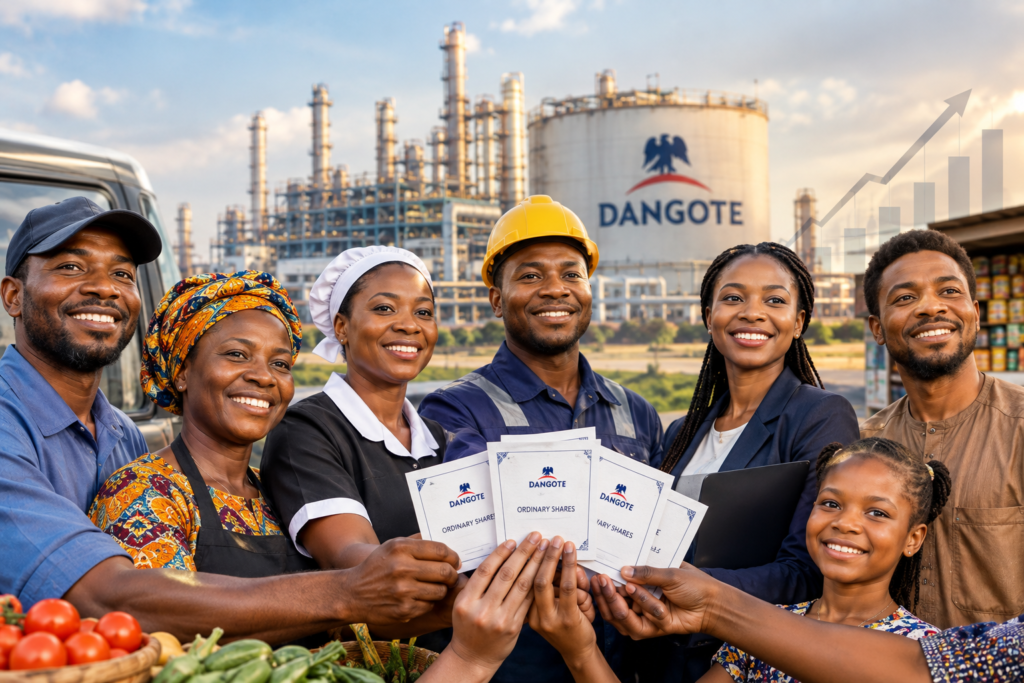
He is not merely saying that his drivers, cooks, servants and managers should benefit from
the refinery through wages or welfare. He is saying they should have an opportunity to own
a piece of it. Ownership creates a fundamentally different relationship between the
individual and the enterprise. An employee who receives a salary is compensated for
labour. A shareholder participates in the value created by the enterprise. A driver who owns
shares is no longer merely transporting executives to work. A cook who owns shares is no
longer simply preparing meals for the workforce. A trader who becomes a shareholder is no
longer merely a customer in the economic chain. The difference may appear technical, but
its social implications are profound; because each becomes, however modestly, an investor
in the productive capacity of the country.
There is also something fundamental about the philosophy. With a target of 10 million
shareholders, it emphasizes on getting as many Africans as possible to participate. And with
his eyes on expanding the already 700,000 b/d capacity refinery to the world’s largest by
2028, there is no doubt that his ambition is not just on physical size but to make the
ownership base equally expansive. That, perhaps, alters Nigeria’s, nay Africa’s, economic
conversation from “need to attract investment, increase production, create employment and
diversify the economy” to “industrialization should not only produce factories; it should
produce owners”. When this takes root, industrialization would not just increase national
output but will fundamentally transform the distribution of economic power. The truth is that
if millions of ordinary people become investors, industrialization begins to acquire a different
social meaning.
The poor do not need pity. What they need is opportunity. By creating this opportunity for
ordinary wage earners, Dangote is not only securing the future of their children. He is
making a fundamental statement to business owners in the country, nay continent. He is
saying, “Prosperity should be transmitted beyond the founders of your businesses”. This is
where the humanitarian dimension of his investment philosophy becomes visible.
Owning 10 shares may not magically transform a poor person into a millionaire, nor should
any responsible investor interpret the IPO as a guaranteed route to wealth. But that a
society becomes more economically inclusive when ordinary citizens are given opportunities
to own productive assets rather than merely consume their output is undeniable. That is
why Dangote’s proposal deserves to be discussed beyond the excitement surrounding the
refinery itself.
There is also a larger African dimension to the initiative. Dangote has repeatedly presented
the refinery not simply as a Nigerian project but as an African industrial asset. His stated
ambition is to accelerate African industrialization, arguing that the continent cannot
industrialize without energy security.
For decades, Africa has exported enormous quantities of raw materials while importing
finished products. Its oil-producing nations have often exported crude and imported refined
petroleum products. Its agricultural economies have exported commodities while importing
processed foods and manufactured goods. The result has been an extraordinary leakage of
value.
Dangote’s stated philosophy is that Africa should increasingly process its own raw
materials, build its own industrial capacity and create its own large corporations. More
importantly, he argues that Africans themselves should participate in owning those
corporations. That is where the refinery IPO potentially becomes bigger than the Dangote
Group. It becomes an ambitious experiment in African economic ownership.
His most revealing description of this ambition manifests itself when he cites Amazon as
model to enable ordinary investors in Nigeria and Africa experience the kind of wealth
creation associated with early investors in major global corporations. The idea is that an
investment made at an early stage can appreciate enormously over time. That way,
millionaires could be created through investment in the businesses being built rather than
requiring everyone to establish a business of their own.
The important social philosophy embedded here lies in the fact that while not everybody can
become an entrepreneur, establish a factory, raise billions of dollars to build a refinery,
potentially, millions of people can become shareholders in businesses that somebody else
has built. That is one of the great possibilities of modern capitalism when properly
structured: capital ownership can be democratized without requiring every citizen to become
a business founder. For a continent where millions struggle to accumulate sufficient capital
to establish even small businesses, this is significant.
Again, his description of the refinery as a “lifetime investment” that could operate for 50, 60
or 70 years provides another dimension to the argument. He is effectively talking about an
asset that should transcend its founder. That is the essence of legacy. A businessman’s
greatest legacy may not be the size of his personal fortune at the end of his life. It may be
the institutions that continue producing value after he is gone. The refinery, if successfully
operated for generations, could become one such institution.
But there is an even more interesting possibility. If millions of Nigerians and Africans
become shareholders, the refinery would not merely outlive its founder. Its ownership could
gradually become part of the economic inheritance of generations. A situation where a
parent could buy shares for the future of a child and that child could eventually pass them to
another generation, eventually makes the refinery a mechanism through which industrial
wealth can potentially travel from one generation to another.
But, perhaps most compelling is the simplicity of the proposal. By putting 10 shares as the
least offer, Dangote is giving as many Africans as possible the opportunity to get involved.
He says that the doors of capital ownership should not belong exclusively to the wealthy.
And if the proposition succeeds, it could help change the psychology of investment.
Many ordinary Nigerians see the stock market as an arena for banks, pension funds,
wealthy investors and financial professionals. A highly accessible offering involving a
globally significant Nigerian industrial asset could bring millions of new people into the
culture of investment. That could be a more important legacy than the immediate proceeds
of the IPO.
Perhaps, one final word: the ordinary Nigerian should be given the opportunity to access
these shares. There should be transparency in the dispensation and administration of the
shares. It is only then that the “IPO for the People” can achieve the objectives of the
Dangote Philosophy.
.