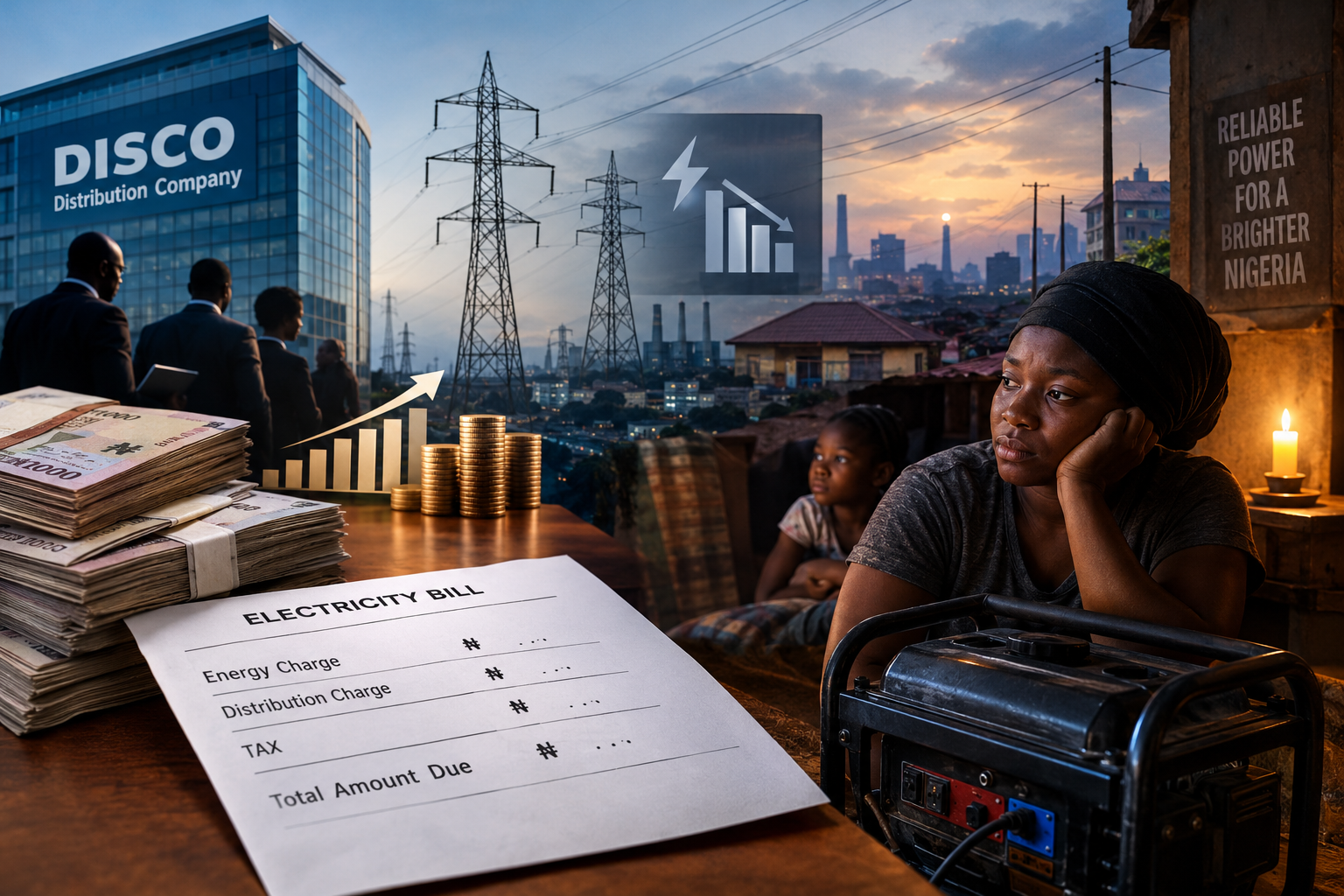
NIGERIA’S POWER PARADOX: TRILLIONS FOR DISCos, DARKNESS FOR CONSUMERS

Thirteen years after privatisation, electricity distributors are collecting trillions of naira while supply remains unreliable, generation capacity is shrinking and government is borrowing to settle mounting debts. Yet the Minister of Power insists that things are improving. Between official optimism and the daily experience of millions of Nigerians lies a troubling question: who is benefiting from the power sector reform?
Nigeria’s electricity industry is, indeed, a contradiction. Or how else could one describe a power sector in which revenues soar while electricity supply barely grows, available generation capacity declines and millions of consumers remain condemned to the indignity of paying for electricity they cannot reliably access.
According to recent reports, the distribution companies, known as DisCos, are reportedly collecting trillions of naira from consumers, yet the electricity they deliver remains frustratingly inadequate. And this is thirteen years after the Federal Government handed the sector to private investors in the hope of ending decades of inefficiency. Today, however, that promise of privatisation remains largely unfulfilled for millions of households and businesses.
According to data from the Nigerian Electricity Regulatory Commission (NERC), analyzed by Financial Vanguard, DisCos’ revenue rose from N218.16 billion in the first half of 2018 to N1.2 trillion in the corresponding period of 2026. That represents an increase of approximately 450 per cent in eight years. Over the same period, electricity supply grew by a mere 4.8 per cent, from 16,861 gigawatt-hours to 17,668GWh. Worse still, average available generation capacity fell by approximately 41 per cent, from 7,565.5 megawatts to 4,456MW.
Analytically, therefore, the financial fortunes of the distribution companies have improved dramatically over those years, but the quality and reliability of the service for which consumers pay have not kept pace. That is the central irony of Nigeria’s electricity crisis. In other words, Nigerians are paying considerably more into a system that has barely provided them with considerably sufficient electricity to serve their needs. For many, the experience is not merely one of inadequate supply, but of an expensive struggle to secure an essential service that should be dependable.
Bode Fadipe, a lawyer and Lead Consultant on the power sector at Sage Consulting, may, therefore, be speaking the minds of all consumers when recently he declared that the figures confirmed what millions of consumers have long suspected. In his words, “What this data has just confirmed is that Nigerians have been paying for darkness”.
As harsh as his verdict may sound to some people, it is still one that captures the frustration of households forced to purchase petrol or diesel for generators, invest in inverters and solar panels, and still pay electricity bills. In effect, many Nigerians pay for two parallel systems: the public electricity network that frequently disappoints them and the private alternatives they must maintain to keep their homes and businesses functioning. For manufacturers, small businesses, hospitals, schools and households, the cost of this contradiction is enormous. Unreliable electricity translates into higher operating expenses, reduced productivity, diminished competitiveness and a lower quality of life. The consequences extend far beyond the monthly electricity bill.
When the power sector was privatized in November 2013, the underlying argument was that private investors, driven by commercial incentives and supported by effective regulation, would bring capital, technical competence and managerial discipline into an industry weakened by decades of public-sector inefficiency. It was expected that generation companies would improve the production of electricity, distribution companies would reduce losses and collect revenue efficiently, while the Federal Government would retain responsibility for transmission through the national grid. Indeed, the expectation of Nigerians was that private ownership would transform electricity from a chronic national liability into a dependable economic utility. Unfortunately, 13 years later, the results remain deep disappointing.
In 2016, DisCos collected approximately N302.93 billion in revenue. By 2025, their collections had risen to N2.3188 trillion, an increase of about 666 per cent. Over the same period, annual electricity supply rose from 23,742GWh to 31,251GWh, an increase of approximately 31.6 per cent. The disparity becomes even more when the figures for 2024 and 2025 are compared. Annual electricity supply fell from 37,093.70GWh in 2024 to 31,251GWh in 2025, a decline of approximately 15.7 per cent. Nevertheless, DisCos’ revenue increased from N1.6597 trillion to N2.3188 trillion. In other words, revenue climbed even as supply deteriorated.
Agreed that revenue and electricity supply are not directly comparable measures. This is because tariff increases, inflation, changes in billing efficiency, customer numbers and collection rates can raise nominal revenue without a corresponding increase in the volume of electricity delivered: and that the revenue collected by DisCos automatically translate into profit, since they have substantial obligations to other participants in the electricity market. But that qualification does not weaken the fundamental argument that if consumers are paying more, they should receive measurable improvements in return. They are also entitled to know why, with increased revenue collections, the DisCos have failed to make the necessary investment in infrastructure to improve service delivery. A sector cannot credibly claim success simply based on increase in commercial receipts only. Its success must also be measured by the quality, quantity and reliability of the electricity delivered.
But, perhaps, the most disturbing aspect of the figures is the decline in available generation capacity. Nigeria has installed generation capacity exceeding 13,000MW, yet much of that capacity has not consistently translated into electricity available to consumers. In 2016, the average available capacity of 27 power plants was approximately 7,527MW, while average actual generation stood at 3,276MW.
By 2025, average available capacity had fallen to about 5,398MW, while average generation rose to approximately 4,475MW. But although the increase in average generation is a positive development, it does not erase the deterioration in available capacity, which has, over the years developed as a result of gas supply constraints, inadequate maintenance, equipment failures, liquidity shortages and transmission limitations. This gap between what the country has installed and what it can reliably produce has, indeed, contributed to the sector’s difficulties and exposed the generational weaknesses of the system’s entire value chain. The challenge is therefore not simply a shortage of generating plants but the failure to make existing infrastructure function consistently and efficiently.
That is where the distribution companies come in. Fadipe’s argument that inadequate investment is a major reason the improvements in revenue have not been matched by better service captures the situation precisely. The DisCos cannot escape scrutiny by pointing to problems elsewhere in the electricity value chain while they are responsible for the infrastructure and commercial operations that connect available electricity to consumers.
Fadipe also supported NERC’s directive requiring DisCos to retain part of their revenue for investment noting that the companies had protested the measure before the regulator insisted on its implementation. But that raises another critical question which borders on accountability. How much of the money collected by each distribution company is actually being reinvested in the networks it operates? So, in insisting on the implementation of its directive, the regulator should require transparent, independently verified disclosures showing the amount collected, the amount invested, the projects completed, the losses reduced and the service improvements achieved.
A forensic audit of DisCos’ capital expenditure, as advocated by him, would help establish whether funds earmarked for infrastructure have been properly utilized. Such an exercise should distinguish between expenditure genuinely made to improve the network and routine operational costs presented as evidence of investment. Building additional plants without addressing the reasons existing ones cannot operate at full capacity risks committing more public resources to assets that may reproduce the same problems.
Nigeria needs dependable megawatts, not merely impressive figures on paper. The recent published records of the Rural Electrification Agency (REA) that estimated 85 million Nigerians who still lack access to electricity makes this most urgent: because for these citizens, the privatisation debate is about whether they can obtain the electricity required for education, healthcare, commerce and ordinary domestic life. A country aspiring to industrialize cannot indefinitely tolerate such a deficit.
by Mac Durugbo